
Move the heat that everything else leaves behind.
Graphene thermal films, interface materials, graphite sheets and cooling components for the highest heat-flux electronics being built today.
The interface is the bottleneck
Cooling capacity keeps growing. The layer between the package and the cold plate has not kept up, and it is usually the layer nobody measures. Conventional greases and pads sit under 10 W/m·K through the thickness, so heat that the cooling system is perfectly capable of carrying away never reaches it.
That is the layer we make. Not heat sinks, not chillers — the material in the gap, and the components immediately around it.
Where our material goes
Spread it
Highly oriented graphene film and graphite sheet move heat sideways, away from a hot spot, before it ever reaches a sink. Our film holds its conductivity at thicknesses where conventional graphite sheet falls off sharply.
Push it through
Through-plane film and vertically aligned graphene give heat a direct vertical path out of the package, in place of grease, pads or liquid metal.
Keep contact
Elastic graphene foam and phase change materials conform to real surface flatness and hold contact through thermal and mechanical cycling, instead of pumping out of the joint.
Two numbers worth knowing
Both describe the through-thickness direction, which is where interface materials usually run out of road.
Through-plane conductivity of our graphene thermal film, across a thickness range from thin die-level interfaces to thick tolerance-absorbing gaps.
Through-plane conductivity of vertically aligned graphene, engineered for the highest-power accelerator packages now shipping.
Where conventional thermal grease and pads sit in the same direction. This is the gap our material exists to close.
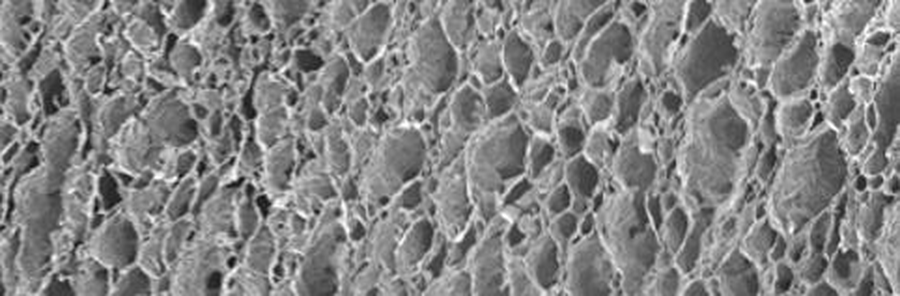
Graphene foam structure, scanning electron micrograph
Contact, not just conductivity
Interface resistance in a real assembly is usually set by the air trapped between two imperfect surfaces, not by the number printed on a datasheet. Rigid materials bridge the peaks and leave voids in the valleys.
Our graphene foam is genuinely elastic and compressible — a patent-protected construction. It conforms under load, and it recovers with the joint through cycling rather than migrating out of it the way a grease does.
Built into
The same material families serve very different thermal problems. These are the platforms they are specified into.
AI servers and GPUs
Through-plane film, vertically aligned graphene and elastic foam at the accelerator interface.
Data center infrastructure
Cold plate interfaces, heat spreading and coatings for air- and liquid-cooled builds.
EV battery and power electronics
Flexible film and pads for cell-to-pack spreading, and interfaces rated for automotive temperatures.
Mobile and foldables
Thin, flexible film with an intact sp² network that survives repeated bending.
Send us the hot spot.
We will send back material.
Tell us the power, the envelope, the mounting pressure and what you run today. We cut evaluation parts to your geometry and give your team the data to bench them against the incumbent.
Common questions
What does GTM actually supply?
Thermal interface materials and heat-spreading materials: graphene thermal film in both in-plane and through-plane orientations, vertically aligned graphene, elastic graphene foam, thermal grease, graphene-silicone soft pads, phase change materials, artificial and flexible graphite sheet, copper vapor chambers, graphene-enhanced metal cooling components and coatings.
Why does through-plane conductivity matter more than in-plane for an accelerator?
Heat has to leave the package vertically before anything else can carry it away. In-plane conductivity spreads heat sideways across a sheet, which helps with hot spots, but it does nothing for the vertical path from die to cold plate. Conventional greases and pads sit under 10 W/m·K in that direction, which is why the interface is usually the limiting layer.
Can graphene film replace liquid metal in a liquid-cooled server?
Our through-plane thermal film is specified in place of liquid metal in liquid-cooled AI servers. It avoids the handling difficulty, corrosion behaviour and electrical short-circuit exposure that liquid metal carries, without giving up the vertical heat path.
How do I get full specifications?
Request the datasheet from any product page. Full grade-by-grade property tables, tolerances, test conditions and reliability data are supplied under NDA at the sampling stage, together with evaluation material cut to your geometry.